

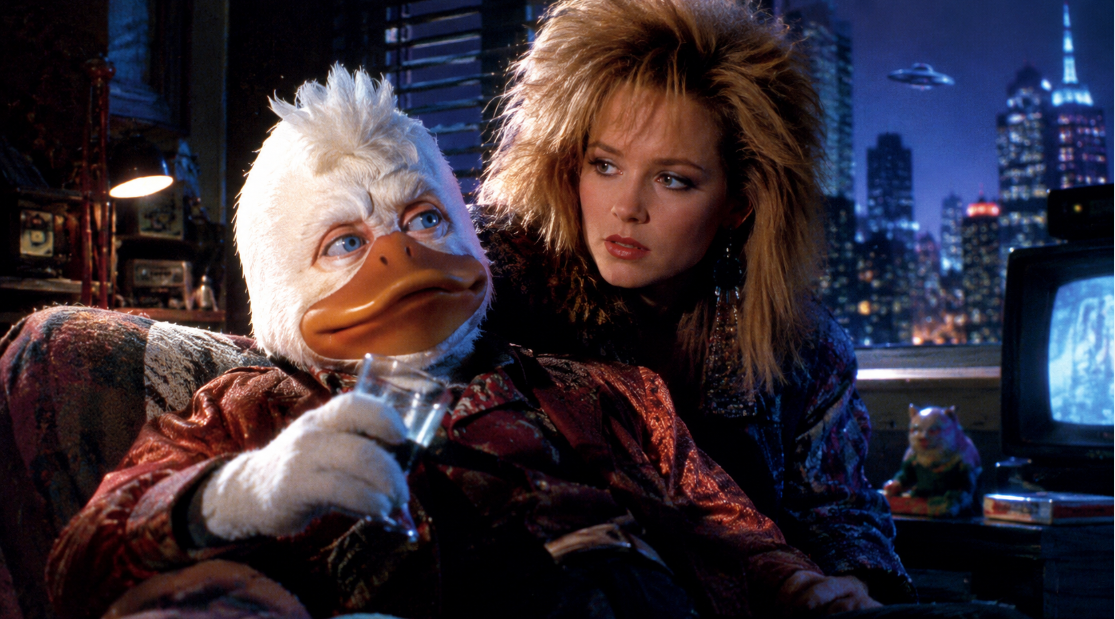
Howard the Duck is a science-fiction comedy film released in 1986, bringing one of Marvel Comics’ most unconventional characters to the big screen. Directed by Willard Huyck and produced by Gloria Katz, the movie follows an intelligent, talking duck who is transported from his home planet to Earth and becomes caught up in an extraordinary adventure.
Starring Lea Thompson, Jeffrey Jones and Tim Robbins, the film combines comedy, science fiction, romance and action. George Lucas served as executive producer, while Lucasfilm handled production and Universal Pictures distributed the movie. Despite its ambitious concept, Howard the Duck received largely negative reviews and struggled at the box office. Over time, however, it has remained a distinctive entry in the history of comic-book adaptations, particularly because of the character’s later appearances in Marvel films.
Howard the Duck Overview

| Detail | Information |
|---|---|
| Title | Howard the Duck |
| Release year | 1986 |
| US release date | August 1, 1986 |
| Country | United States |
| Language | English |
| Director | Willard Huyck |
| Screenplay | Willard Huyck and Gloria Katz |
| Producer | Gloria Katz |
| Co-producer | Robert Latham Brown |
| Executive producer | George Lucas |
| Production company | Lucasfilm |
| Distributor | Universal Pictures |
| Genre | Science-fiction comedy, adventure |
| Runtime | Approximately 110 minutes |
| Rating | PG |
| Based on | Marvel Comics character Howard the Duck |
Howard the Duck stands apart from conventional superhero films because its main character is neither a human hero nor a traditional crime-fighting vigilante. Instead, Howard is a sarcastic, independent-minded duck whose unexpected arrival on Earth sets an unusual story in motion.
The film draws inspiration from the Marvel Comics character created by Steve Gerber and Val Mayerik. However, the movie develops its own approach to the material, mixing extraterrestrial adventure with romantic comedy, rock music and creature-feature elements.
Story and Premise
The story begins on Duckworld, a planet inhabited by intelligent, human-like ducks. Howard T. Duck leads a relatively ordinary life until an unusual scientific event transports him across space and brings him to Cleveland, Ohio.
Suddenly stranded in an unfamiliar environment, Howard has to navigate a world populated by humans who are surprised by his appearance and personality. His situation changes when he meets Beverly Switzler, a musician attempting to build a career with her rock band. Their unlikely friendship becomes an important part of the story as Howard searches for a way to understand his arrival and find a path home.
Howard also encounters Phil Blumburtt, a scientist whose work becomes connected to the extraordinary events surrounding the duck’s appearance. What initially seems like a bizarre accident gradually develops into a more serious problem involving experimental science and an extraterrestrial threat.
As the danger increases, Howard and his companions must work together to prevent the situation from becoming catastrophic. The story combines humour with science-fiction suspense, using Howard’s sharp observations and refusal to accept ordinary expectations as recurring sources of comedy.
Rather than presenting a conventional superhero origin, the movie focuses on an outsider attempting to make sense of a world that was never designed for him.
Cast and Characters
The film features a principal cast of established performers and supporting actors who contribute to its unusual blend of comedy, adventure and science fiction.
| Actor | Character |
|---|---|
| Ed Gale | Howard T. Duck, physical performer |
| Chip Zien | Howard T. Duck, voice |
| Lea Thompson | Beverly Switzler |
| Jeffrey Jones | Dr. Walter Jenning |
| Tim Robbins | Phil Blumburtt |
| Paul Guilfoyle | Lieutenant Welker |
| Holly Robinson Peete | K.C. |
| Dominique Davalos | Cal |
| Richard Edson | Ritchie |
| Miles Chapin | Carter |
| Richard Kiley | The Cosmos, voice |
Ed Gale and Chip Zien as Howard the Duck
Howard is the film’s central character, and his portrayal required more than conventional live-action acting. Ed Gale performed as Howard on screen, while Chip Zien provided his speaking voice.
Combining the physical performance with a separate voice performance allowed the filmmakers to create a character who could interact with human actors while retaining a distinctive personality. Howard’s sarcastic dialogue, frustration with his circumstances and independent attitude form the foundation of the film’s humour.
Lea Thompson as Beverly Switzler
Lea Thompson plays Beverly Switzler, a musician who becomes Howard’s closest human companion. Beverly’s involvement in the local music scene gives the film a rock-and-roll atmosphere, while her growing friendship with Howard provides an emotional thread running through the story.
Thompson was already known to film audiences in the 1980s and later became especially recognisable for her role as Lorraine Baines in the Back to the Future trilogy.
Jeffrey Jones as Dr. Walter Jenning
Jeffrey Jones portrays Dr. Walter Jenning, a scientist whose experiments help drive the film’s central conflict. His character becomes increasingly significant as the story moves from unusual encounters towards a more dangerous science-fiction scenario.
Tim Robbins as Phil Blumburtt
Tim Robbins plays Phil Blumburtt, a scientist who becomes involved in Howard’s predicament. His character adds comic moments to the adventure and helps connect the extraordinary events to the human world.
Robbins later earned widespread recognition for performances in films including Bull Durham, The Shawshank Redemption and Mystic River.
Supporting Cast
Paul Guilfoyle, Holly Robinson Peete, Dominique Davalos, Richard Edson and Miles Chapin appear in supporting roles that help establish the film’s wider cast of characters. Richard Kiley contributes a voice performance as the Cosmos, adding another element to the movie’s unusual science-fiction world.
Director and Production
Willard Huyck directed Howard the Duck and co-wrote the screenplay with Gloria Katz, who also served as the film’s producer. The pair had previously collaborated with George Lucas on American Graffiti (1973) and Indiana Jones and the Temple of Doom (1984).
Lucas served as executive producer through Lucasfilm, the production company behind the movie. Robert Latham Brown was the co-producer, while Universal Pictures handled theatrical distribution.
The production aimed to bring Howard to life as a convincing character who could interact naturally with human performers. This required extensive costume work, practical effects and a dedicated physical performance, making the character one of the film’s most technically demanding elements.
The filmmakers also adapted the comic-book property for a mainstream theatrical audience. While the original comics were known for satire and unconventional storytelling, the movie placed greater emphasis on an accessible science-fiction adventure with comedy, romance and action.
Filming and Development
Development of the film began several years before its theatrical release. An earlier version of the project was explored in 1981, before the production eventually moved forward with Lucasfilm and Universal Pictures.
Principal photography took place from November 1985 to March 1986. Northern California served as the primary filming region, with locations in and around San Francisco standing in for Cleveland, Ohio, where much of the story takes place.
The production made use of specialised sets and effects to depict Howard’s arrival on Earth and the scientific experiments that drive the plot. Industrial Light & Magic, the effects company associated with Lucasfilm, contributed to the film’s visual effects work.
Creating a believable talking duck presented particular challenges. Howard needed to display expressive movements and deliver comic performances while remaining visually consistent with the film’s live-action environment. The production combined a performer in costume with voice acting and practical techniques to achieve this.
The project was ambitious for its time, particularly because the central character was an anthropomorphic duck rather than a conventional human protagonist. The technical demands and unusual premise helped distinguish the movie from other theatrical releases of the period.
Release and Distribution
Howard the Duck was released in US cinemas on August 1, 1986. Universal Pictures distributed the film, which received a PG rating for its theatrical release.
The movie arrived during the summer season, when studios traditionally compete for large audiences with adventure films, comedies and other commercial releases. Its association with Lucasfilm and George Lucas gave it considerable visibility before its debut.
However, the film’s combination of romance, science fiction, comedy and darker creature-feature elements made it an unusual proposition for general audiences. Its tone differed from the more straightforward adventure films with which Lucas was associated.
Following its theatrical run, Howard the Duck became available through home-video releases and subsequent digital distribution. These later releases have helped maintain interest in the film among viewers exploring 1980s cinema and the history of Marvel adaptations.
Box Office Performance
Howard the Duck failed to achieve the commercial success expected of a major summer release.
| Box office detail | Reported figure |
|---|---|
| Estimated production budget | $30–37 million |
| US and Canadian gross | Approximately $16.3 million |
| International gross | Approximately $21.7 million |
| Worldwide gross | Approximately $38 million |
| Opening weekend in North America | Approximately $5.1 million |
Reported figures vary slightly between box-office databases, particularly regarding the production budget. The worldwide total is generally reported at around $38 million.
Although the film earned money from theatrical ticket sales, its box-office performance was disappointing relative to the reported production costs. Furthermore, box-office gross does not represent the amount received by the studio, as cinemas retain a portion of ticket revenue and distribution, marketing and other expenses must also be considered.
The movie’s commercial performance became one of the defining aspects of its original reputation. It is frequently cited as an example of a high-profile production whose ambitions and unusual concept did not translate into a successful theatrical run.
Critical Reception
The original critical response to Howard the Duck was largely negative. Reviewers commonly criticised its humour, inconsistent tone and story, with some finding the mixture of comedy, romance and science-fiction horror difficult to reconcile.
One of the film’s central challenges is its attempt to combine several distinct styles. Howard’s sarcastic personality suggests a satirical comedy, while the developing relationship between Howard and Beverly introduces romantic elements. The later threat adds a more serious science-fiction dimension.
For many critics, these components failed to form a consistently engaging whole. The film’s visual effects and elaborate production also attracted attention, but technical ambition alone could not overcome the weaknesses identified in its storytelling.
Audience responses have been mixed as well. Some viewers continue to regard the movie as an entertaining example of eccentric 1980s filmmaking, while others share the criticisms that shaped its initial reception.
Its reputation has nevertheless evolved beyond its original reviews. The film remains a subject of discussion among fans interested in cult cinema, practical effects and the development of comic-book adaptations before the modern superhero blockbuster era.
Awards and Recognition
Howard the Duck received considerable attention at the 1987 Golden Raspberry Awards, commonly known as the Razzies, which highlight films regarded as among the year’s weakest releases.
The movie received seven nominations and won four awards, according to commonly reported records. Its wins included Worst Picture, Worst Screenplay, Worst New Star for the performers portraying Howard, and Worst Visual Effects.
These awards reinforced the film’s reputation as a critical disappointment. However, negative recognition has also contributed to its lasting visibility, ensuring that the movie remains part of conversations about controversial or unsuccessful studio productions of the 1980s.
Legacy and Cultural Impact
A distinctive Marvel adaptation
Howard the Duck first appeared in Marvel Comics in 1973, created by writer Steve Gerber and artist Val Mayerik. The character became known for his sarcastic personality, absurd situations and stories that satirised familiar conventions of comics and popular culture.
The 1986 film brought the character to cinemas at a time when comic-book adaptations were far less common as major Hollywood productions than they would become in the following decades.
Although the movie was poorly received, it remains notable for attempting to build a live-action feature around such an unconventional comic-book character. Its mixture of practical creature effects, comedy and science fiction also makes it a distinctive example of 1980s studio filmmaking.
Howard’s connection to the Marvel Cinematic Universe
The original Howard the Duck movie is not part of the Marvel Cinematic Universe (MCU). However, the character later appeared in the MCU, introducing him to a new generation of viewers.
Howard made a brief appearance in the post-credits scene of Guardians of the Galaxy (2014), voiced by Seth Green. He subsequently appeared in Guardians of the Galaxy Vol. 2 and Avengers: Endgame, among other Marvel productions.
These appearances connect the character to the wider Marvel film franchise, but they do not establish the 1986 movie as part of MCU continuity. The later portrayal is a separate interpretation of the comic-book character.
A lasting cult-film reputation
The movie’s reputation as a critical and commercial disappointment has not prevented it from developing a lasting place in popular culture. Its unusual premise, memorable character design and connection to George Lucas continue to attract attention from film enthusiasts.
For some viewers, its eccentricity is precisely what makes it interesting. For others, it serves as a reminder that a recognisable comic-book character and an ambitious production do not automatically guarantee a successful film.
Regardless of opinion, Howard the Duck remains a notable chapter in Marvel’s screen history and an unusual precursor to the comic-book adaptations that later became major Hollywood franchises.
Frequently Asked Questions
1. When was Howard the Duck released?
The film was released in US cinemas on August 1, 1986. Universal Pictures served as its theatrical distributor.
2. Who directed Howard the Duck?
Willard Huyck directed the movie and co-wrote its screenplay with Gloria Katz. Katz also produced the film, while George Lucas served as executive producer.
3. Who played Howard the Duck?
Ed Gale performed Howard on screen, while Chip Zien supplied the character’s speaking voice. The production combined their contributions to create the film’s central character.
4. What is Howard the Duck about?
The story follows an intelligent duck transported from his home planet to Earth. After meeting musician Beverly Switzler and scientist Phil Blumburtt, Howard becomes involved in a dangerous situation involving experimental science and an extraterrestrial threat.
5. Is Howard the Duck part of the Marvel Cinematic Universe?
No. The 1986 film exists separately from the MCU. However, Howard later appeared in MCU productions, beginning with Guardians of the Galaxy in 2014.
6. How much did Howard the Duck earn at the box office?
The film earned approximately $38 million worldwide, including around $16.3 million in the United States and Canada. Reported production-budget estimates range from $30 million to $37 million.
7. Did Howard the Duck win any awards?
The film won four Golden Raspberry Awards in 1987, including Worst Picture and Worst Screenplay. It also received nominations in several categories.
8. Is there a direct sequel to Howard the Duck?
No direct theatrical sequel to the 1986 movie has been released. Howard has appeared in later Marvel productions, but these appearances are separate from a direct continuation of the original film’s story.
