

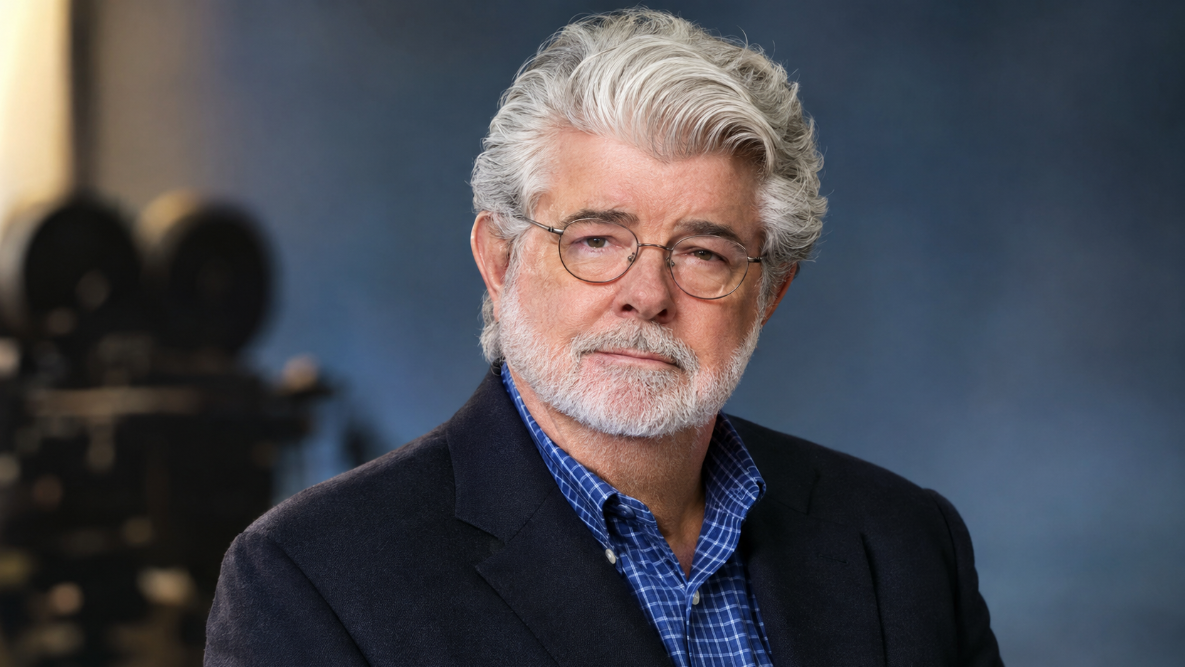
George Lucas is an American filmmaker, screenwriter and producer best known for creating Star Wars, one of the most influential science-fiction franchises in cinema history. His work has shaped blockbuster filmmaking through imaginative storytelling, memorable characters and advances in visual effects. Beyond directing, Lucas has helped develop technologies and production companies that changed how films are made and experienced.
Early Life and Background
Born on May 14, 1944, in Modesto, California, Lucas initially considered a future in illustration and developed an interest in photography, cars and mechanical design. A serious car accident after high school changed his plans, leading him toward further education rather than a career in motor racing.
He attended Modesto Junior College before transferring to the University of Southern California’s School of Cinematic Arts. There, he explored experimental filmmaking and developed the technical and storytelling skills that would define his career. His student films attracted attention and helped establish his reputation as a promising young filmmaker.
Career Highlights
Lucas made his feature-film debut with THX 1138 (1971), a science-fiction drama about a tightly controlled future society. Although it was not an immediate commercial success, the film demonstrated his interest in technology, social structures and unconventional storytelling.
His breakthrough came with American Graffiti (1973), a coming-of-age film inspired by teenage life in early-1960s America. Its commercial success established him as a director and gave him greater freedom to pursue an ambitious science-fiction project.
That project became Star Wars (1977), later subtitled Star Wars: Episode IV – A New Hope. The film’s success transformed Lucas’s career and established a franchise spanning movies, television, publishing and other entertainment. He subsequently directed The Empire Strikes Back (1980) as an executive producer and story contributor, and Return of the Jedi (1983) as a story contributor and executive producer.
Most Famous Work and Industry Impact
The Star Wars universe remains his defining achievement, but Lucas also helped shape the Indiana Jones franchise alongside filmmaker Steven Spielberg. He co-created the adventurous archaeologist’s screen adventures, combining action, humour and classic serial-inspired storytelling.
His influence extends beyond directing. Lucas established Industrial Light & Magic to create the visual effects needed for Star Wars, helping advance techniques that became important throughout the film industry. His companies also contributed to developments in sound, editing and computer-generated imagery.
In 2012, he sold Lucasfilm to The Walt Disney Company, transferring the Star Wars franchise to new ownership while securing the future of the company he had built.
Current Career and Legacy
Lucas has largely stepped away from directing major studio productions, focusing instead on philanthropy and long-term creative projects. His educational work includes support for film education and initiatives promoting innovative approaches to learning.
The Lucas Museum of Narrative Art, a project dedicated to visual storytelling across different forms, represents another part of his ongoing contribution to culture. His legacy rests not only on the fictional worlds he created but also on the filmmaking tools and institutions that continue to influence the industry.
